

How Go-to-Market Strategy Drives EBITDA
 Dan Fisher: Aug 19, 2026, 8:45:46 AM
Why Your Sales Problem Is Actually a Valuation Problem: How Go-to-Market Strategy Drives EBITDA

You built your IT staffing firm from the ground up. You landed the early clients, trained your reps and recruiters, and figured out what worked. And for a while — maybe a long while — it worked really well.
But somewhere along the way, your firm quietly built itself around a dangerous architecture: one where revenue doesn't flow from a system. It flows from a person.
That's the sales superhero model. And if you're running an IT staffing firm, it is highly likely it's quietly putting a ceiling on your growth, a floor under your stress, and an expiration date on your business.
What Is the Sales Superhero Model?
The sales superhero model is a revenue structure in which one or two individuals — often the founder, a founding partner, or a long-tenured account executive — are responsible for generating the overwhelming majority of a firm's revenue.
This person has the relationships. They know the clients. They know what to say and when to say it. They've built trust over years, sometimes decades. They are, by every measure, exceptional.
And that is precisely the problem.
In the sales superhero model:
The superhero wins deals through intuition, personality, and personal relationships — not through a repeatable process
The rest of the sales team operates without a shared playbook, often improvising their way through the sales cycle
Managers coach inconsistently because there's no defined methodology to coach to
New hires are expected to "figure it out" the same way the superhero did — which rarely happens
Revenue results are unpredictable because they depend on individuals, not infrastructure
This is not a performance problem. It's a structural one.
Why IT Staffing Firms Are Especially Vulnerable
The IT staffing industry is relationship-driven by nature. Clients buy from people they know and trust. That's not going away. But there's a meaningful difference between leveraging relationships and depending on them as your only sales strategy.
Most IT staffing firms were started by a strong salesperson or recruiter — someone who could walk into a room and close. That person built the business. But they also, often without realizing it, built the business around themselves. The result is a firm that looks healthy from the outside — clients, revenue, a team — but is structurally fragile at its core.
When I work with IT staffing firms across the country, I ask the same questions regardless of firm size:
What's your definition of a qualified job order?
What's your process for handling a price objection?
How do you coach a rep who's struggling to open new accounts?
What does your onboarding program look like for new salespeople?
The answers are almost always inconsistent — different by rep, different by manager, different by office. That inconsistency is the fingerprint of the superhero model.
What the Sales Superhero Model Actually Costs Owners
This is where it gets uncomfortable. Because the superhero model doesn't just limit your firm's growth. It costs the owner in ways that are easy to miss when the revenue is coming in.
1. You can't take a real vacation.
When your revenue depends on one or two people — including, often, yourself — there is no such thing as a true break. Your phone goes with you. You check email from the beach. You take calls on the golf course. Because if the superhero is unavailable, deals stall. Clients get nervous. And the team doesn't have a system to fall back on.
2. Your business is worth far less than you think.
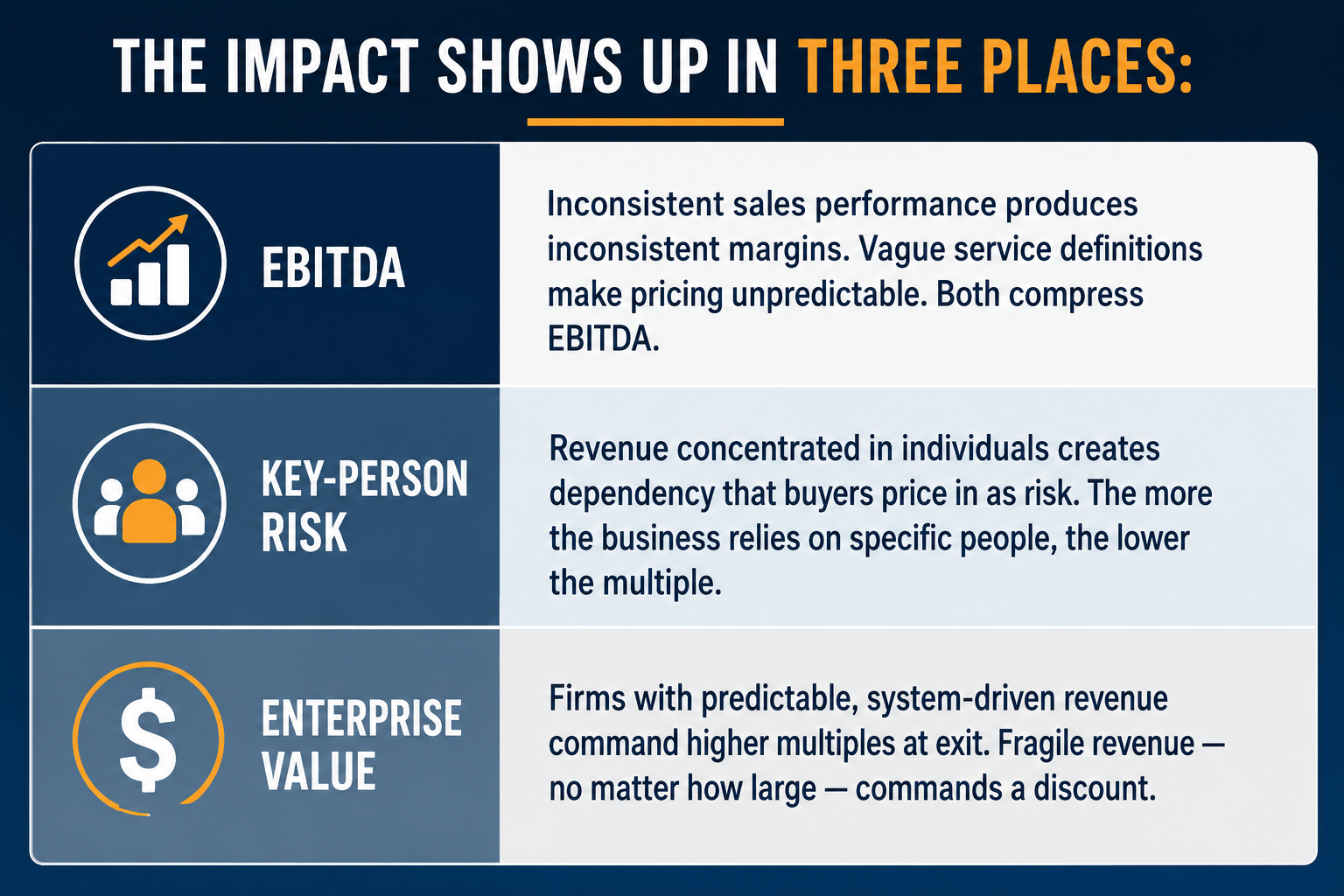
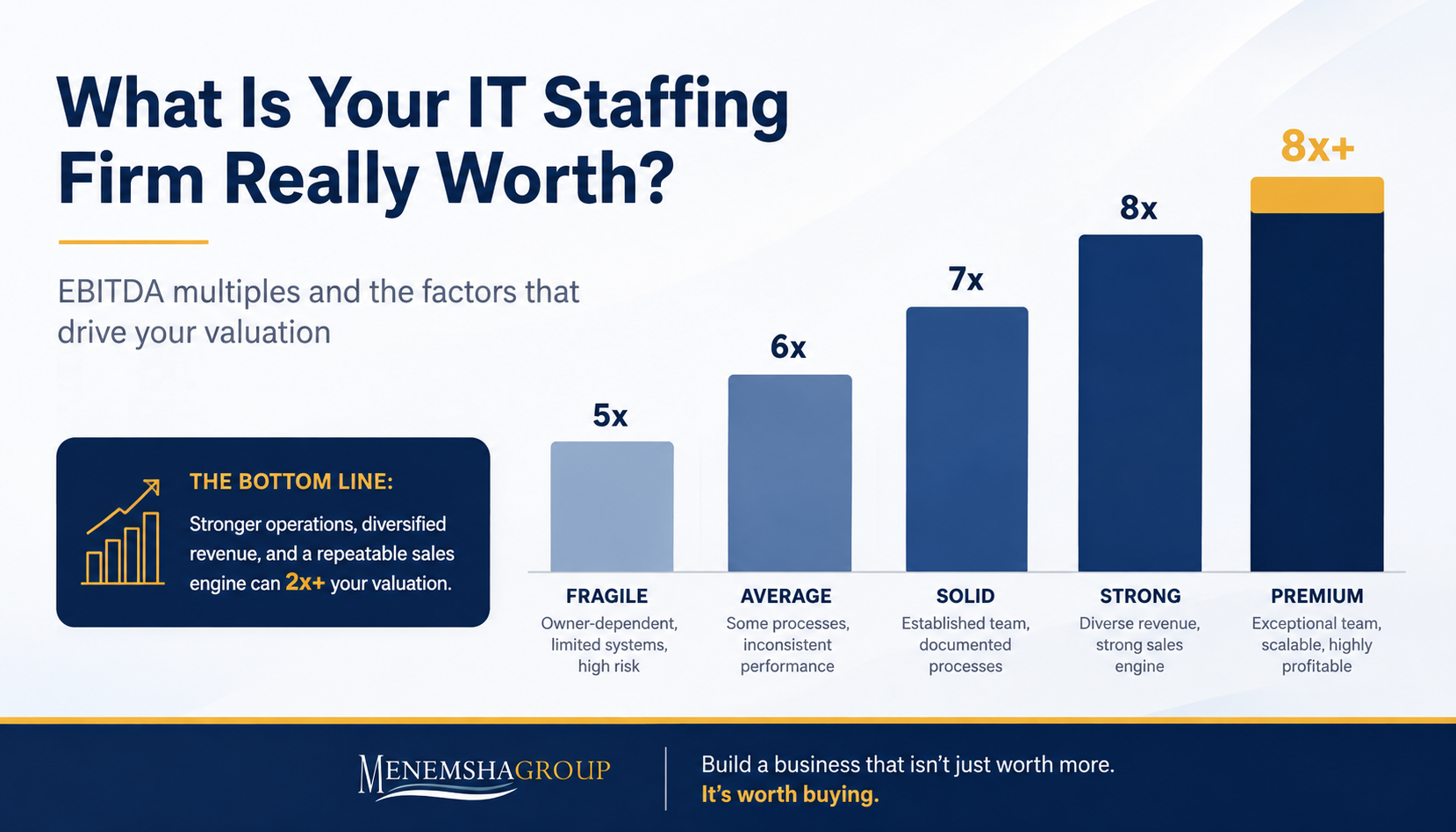
Here's a truth that most IT staffing firm owners don't confront until they're ready to exit: buyers don't pay premium multiples for revenue that walks out the door. When a significant portion of your firm's revenue is tied to the relationships of one or two people, sophisticated buyers discount your valuation — dramatically. They call it customer concentration risk, key-person dependency, and revenue fragility. All of it translates to a lower offer, harder deal terms, or no deal at all.
If your five-year plan includes a sale or recapitalization, the superhero model is quietly eroding the asset you're trying to build.
3. You're trapped in a hiring loop that doesn't work.
Many IT staffing firm owners respond to growth pressure by trying to hire their way out — recruiting senior salespeople who can "hit the ground running." But without a system to plug those hires into, even good salespeople underperform. The onboarding is inconsistent. The coaching is ad hoc. The playbook doesn't exist. And when the new hire struggles, the default reaction is to hire again — creating an expensive, demoralizing cycle.
Talent isn't the answer when the infrastructure isn't there to support it.
4. Your revenue is one resignation letter away from a crisis.
What happens when your superhero leaves? Maybe they retire. Maybe they get recruited away. Maybe they decide they want to go independent. Whatever the reason, when that person walks out, they often take their relationships — and a significant portion of your revenue — with them.
This is not a hypothetical. It happens to IT staffing firms every year. And the ones who recover fastest are the ones who had already built systems that weren't dependent on any single person.
5. You can't scale what you can't replicate.
The superhero's success is not documented. It's not transferable. It lives in their head, in their relationships, in their personal brand. You can't onboard a new rep into that. You can't coach to it. You can't franchise it across offices or geographies.
Real scale requires a system — a defined methodology for how your firm sells, recruits, and delivers — that any capable person can learn and execute. Without it, growth means adding bodies and hoping for the best.
6. The firm reflects your ceiling, not your team's potential.
When the firm's success is tied to the owner or one key performer, the business can only grow as fast as that person can work. There is a hard cap on what one person, no matter how talented, can accomplish in a week, a month, a quarter. If your firm's trajectory is essentially a straight line from your personal calendar, you haven't built a scalable business. You've built a very demanding job.
The Uncomfortable Question
(If you want a deeper look at what the sales superhero model is and the case for building systems instead, I covered the fundamentals in an earlier post: Stop Relying on Heros, Start Building Systems. This post goes further — specifically into what the model costs you as an owner.)
Here's the question I ask every IT staffing firm owner who tells me business is going well:
"If your top salesperson or you were completely unavailable for 90 days, what would happen to your revenue?"
If the honest answer is "it would drop significantly," you're running the superhero model. Not because you're doing anything wrong — but because you haven't yet built the system that makes the answer different.
What the Alternative Looks Like
Escaping the superhero model doesn't mean firing your best performers or ignoring the value of great relationships. It means building the infrastructure around them so that their success can be replicated — and the business doesn't depend on them exclusively.
That looks like:
A defined sales methodology that every rep learns and executes
A structured onboarding program that accelerates time-to-productivity for new hires
A coaching framework that gives managers consistent, skill-based tools to develop their teams
Clear definitions of what a qualified lead, qualified job order, and successful sales conversation look like
A pipeline and activity management system that creates visibility — not dependence
When that infrastructure is in place, you're no longer betting the business on individuals. You're building a revenue engine that's consistent, scalable, and genuinely valuable to you, to your team, and to any future buyer.
The Bottom Line
The sales superhero model isn't a sign that you've failed. It's usually a sign that you've succeeded — at least in the early stages. You found the clients. You hired someone great. Things worked.
But there comes a point where what got you here will actively prevent you from getting where you want to go. If your goal is to build a firm that grows without you grinding, creates real enterprise value, and gives you options — whether that means scale, sale, or just breathing room — the superhero model has to go.
The good news is that building the system isn't as complicated as it sounds. It starts with an honest assessment of where the gaps are. And it ends with a business that works — not because of who you have, but because of what you've built.
If you're ready to stop depending on a few key people and start building the system that makes consistent performance possible across your entire team, this is your next step.
From Rainmakers to Revenue Systems is a free guide that walks IT staffing firm owners through exactly what a sales performance system looks like — and how to build one. You'll learn why training alone doesn't work, what a real sales methodology requires, and how to create an infrastructure that develops reps into consistent producers.

Dan Fisher is the founder of Menemsha Group and creator of the Menemsha Sales Performance System™ (MSPS) — an operating system built exclusively for IT staffing firms. Since founding the company in 2008, Dan has worked with over 500 IT staffing firms and trained thousands of sellers, recruiters, and leaders.
MSPS replaces the "Sales Superhero Model" — where revenue depends on one or two key performers — with a complete system that defines how a team sells, builds the skills to execute it, and creates the management infrastructure to make performance predictable and scalable.
Dan Fisher: Aug 19, 2026, 8:45:46 AM
Why Your Sales Problem Is Actually a Valuation Problem: How Go-to-Market Strategy Drives EBITDA
Dan Fisher: Aug 6, 2026, 9:19:49 AM
ere's a question worth sitting with: if you sold your IT staffing firm and walked away, would your top clients stay — or would they follow you out...