


One System. Fully Integrated. Built for Predictable Revenue.
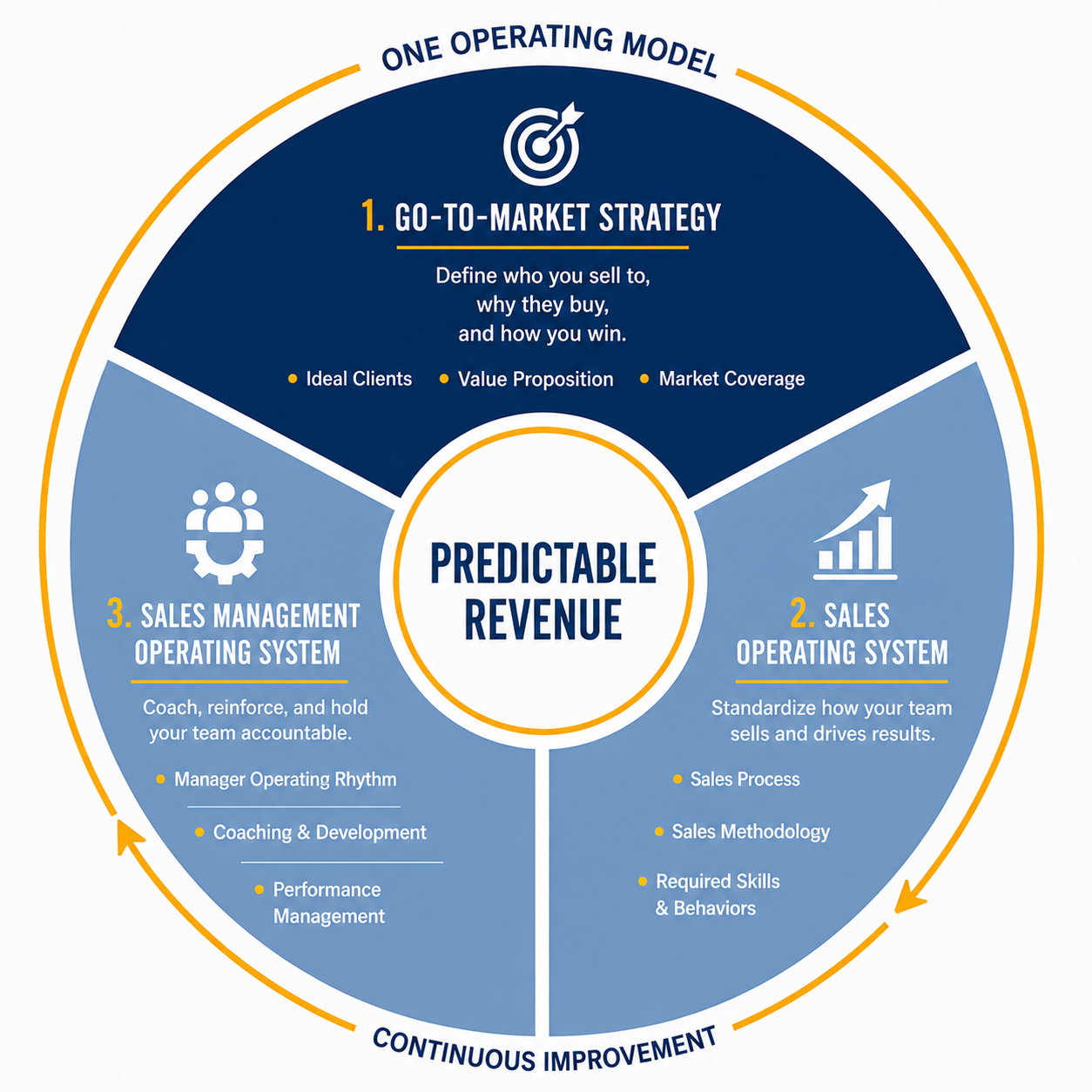
The Menemsha Revenue Operating System™ (MROS) aligns your go-to-market strategy, sales execution, and sales management into one repeatable system that produces predictable revenue.

One Operating Model. Zero Guesswork.
Most IT staffing firms invest in sales training, sales tools and new hires—but without the right operating system, performance remains inconsistent.
With the Menemsha Revenue Operating System™ (MROS), everything works together:
- Go-to-Market Strategy — Define who you sell to, why they buy, and how you win.
- Sales Operating System — Standardize how your team sells.
- Sales Management Operating System — Coach, reinforce, and continuously improve performance.

Go-to-Market Strategy
Before your team can sell effectively, you need to know exactly who you're targeting, what problems you solve, and why a buyer should choose you over every other option.

Manager Enablement
Equip managers with the skills, frameworks, and tools they need to coach effectively run the system, coach and develop sales talent, and build a team that doesn't depend on any one person.

Sales Methodology
Your methodology defines how your team sells across every stage of the sales cycle. It's the standard every rep executes to, every manager coaches to, and every component of MSPS is built around.

Sales Enablement
A methodology means nothing if your team can't execute it. This is how you develop the people to run the system consistently via training, skill certification, coaching, and reinforcement.

Systems and Data
Your CRM/ATS must be configured to support your methodology and your customer's buying process, including verifiable exit criteria. That gives you accurate forecasting and a precise picture of where and why deals stall.

Performance Management
When your systems reflect how your customer buys and your methodology defines how your team sells, you can measure what actually matters — skill execution, deal progression, and verified exit criteria at every stage. This enables managers to stop managing activity and start coaching to outcomes.

Phase 1: Go-to-Market Workshop
We start with a facilitated leadership workshop. Before anything else, owners and leaders define the go-to-market strategy that drives everything downstream — ideal customer profile, value proposition, buyer personas, use cases.nt meh la croix cliche food truck. Shabby chic offal selvage pop-up typewriter.

Phase 2: Sales Methodology Alignment
We define the sales methodology your team will execute. This becomes the standard every rep trains to, every manager coaches to, and every component of the system is built around.

Phase 3: Systems & Infrastructure Build
Before training begins, we configure your CRM/ATS, your dashboards, and establish the tracking infrastructure. We define the metrics, KPIs, and conversion ratios your business will run on — and introduce the Sales Ramp Model, a tool that shows exactly what performance should look like at every stage of a rep's development and how results compound over time.

Phase 4: Sales Training
Training is delivered in five sequential phases — each one building on the last. No phase begins until every rep has earned certification through the one before it.
Certification isn't a quiz. It requires passing competency assessments, completing experiential role play exams, and finishing with a capstone competition that puts every skill to the test in a real-world selling scenarios.

Phase 5: Annual Planning
At the end of Year 1 we review the full system — what's working, what needs refinement, and where the gaps are. We update the GTM strategy, sales methodology, and infrastructure as needed and set the plan for Year 2.

Year 2: Running the MSPS™ System
The system doesn't stop — it compounds. Ten minutes a week protects everything you built in Year 1. New reps enter the system when they join. Tenured reps become eligible for recertification. And every quarter we meet with ownership to review execution and adherence — closing gaps before they become problems.
This is not a one-time implementation. It's an operating rhythm.
Now See Why MROS™ Works When Nothing Else Has.