


How Go-to-Market Strategy Drives EBITDA
 Dan Fisher: Aug 19, 2026, 8:45:46 AM
Why Your Sales Problem Is Actually a Valuation Problem: How Go-to-Market Strategy Drives EBITDA
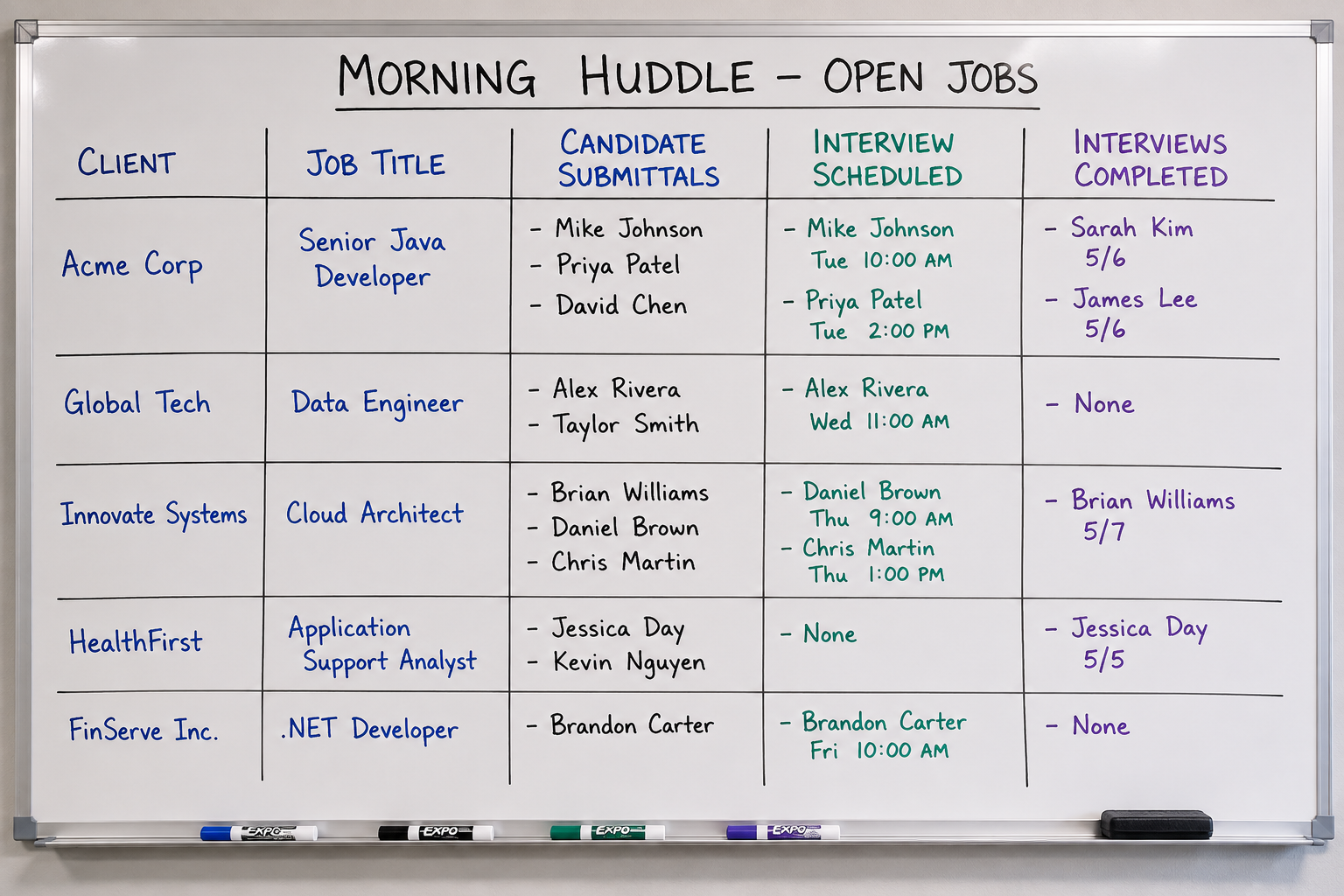
Every morning, staffing firms all across the country gather for the same ritual — the morning huddle. The team reviews every open job. What happened yesterday? What candidates were submitted? Who's interviewing? Who needs follow-up? What are the next steps?
On the surface, these meetings feel productive. Recruiters and sales reps leave with action items. Managers feel like they're driving accountability. But after spending years inside hundreds of IT staffing firms, I've come to believe most morning huddles revolve around the wrong question.
"What is our next step?" Or, "what are we going to do next?"
The better question is: ‘what does our customer need to do next in order to buy (hire my candidate)?’
That single shift changes everything.
Activity Isn't Progress.
Many managers make the mistake of confusing activity with progress. We celebrate things like the client requesting more information, candidates sharing additional information, sending another follow-up email, submitting candidates, leaving a voicemail, scheduling another check-in. Those are all activities. None of them tell you whether the opportunity actually moved.
Only the customer can move an opportunity forward. Submitting three candidates isn't progress — the customer scheduling interviews is progress. Sending a follow-up email isn't progress — the customer agreeing to an intake call is progress. Leaving a voicemail isn't progress — the customer returning your call and making a decision is progress. This sounds obvious once you hear it. Yet most morning huddles spend almost all of their time reviewing what the sales rep or recruiter did instead of what the customer (or candidate) did.
The Job Orders Looked Qualified
I'm currently working with an IT staffing firm whose pipeline looks healthy. They have seventy-five ‘tier 1’ job orders. ‘Tier 1’ means they are high-priority jobs. And this is a small firm with just four sales reps. Candidates are being sourced. Resumes are going out every day. From the outside, it looks like business is humming.
So what is the problem? Well, let’s just say they've got candidates all dressed up and prepared with nowhere to go.
Hiring managers who sounded excited and urgent two weeks ago suddenly need "more time. Candidate feedback has slowed to a crawl. The sales manager’s instinct has been to push the sales reps harder. "Follow up again." "Stay on them." "Keep calling." But the sales team isn't the problem. The company's definition of ‘qualified’ is.
They’ve Been Measuring Activity Instead of Progress
Like most staffing firms, they consider a job order qualified once they have a job description, an approved bill rate, and a target start date. Sound familiar? Those three things describe the opening. What they don’t do is predict how committed the customer is to hiring.
So what did we do? We compared the job orders from their top rep against the job orders brought in from the other three reps.
When we compared them, the difference became astoundingly obvious. The top performer always knew things nobody else knew. For example, he knew why the role existed. He knew what project was behind schedule. He knew what happened (to the hiring manager) if the position stayed open. He knew what it was costing the business. He knew who was personally accountable for getting the position filled.
More importantly, he never asked the recruiting team to start sourcing candidates until the customer demonstrated commitment. Not interest. Commitment. The hiring manager agreed to invest time in a detailed intake meeting. The hiring manager explained the business impact of leaving the role open. They blocked interview times on their calendar before seeing a single resume. Those weren't pieces of information. They were commitments. And commitments predict behavior.
Why Recruiters Become Cynical
This realization explained something else I've witnessed for years — why recruiters become skeptical. They've seen the same client disappear three times. They've sourced candidates for jobs that never existed. They've invested hours screening candidates only to hear "the client decided to put the job on hold." Or worse, nothing at all.
Eventually recruiters protect themselves. Instead of conducting deep searches, they submit candidates without fully vetting them. Not because they don't care. Because experience has taught them not to invest their own personal time and energy until the client proves they're serious.
Think about that. Your recruiters probably — I'm 95% certain they do — have a better qualification process than your sales team. They simply learned it through disappointment instead of design.
Change One Question During Your Morning Huddle
Tomorrow morning, try something different. When a sales rep gives an update, don't ask "What's your next step?" Instead ask: "What has the customer committed to doing next?" Or ask your sales rep, “what is the next step you need ask your client to commit to next?”
If they don’t know the answer to that question then you have big problem. Consider the following. Has the hiring manager scheduled an intake meeting? Have they blocked interview times? Have they introduced you to the interview and hiring team? Have those stakeholders given you their time? Have they committed to providing interview feedback by a specific date and time — and accepted your calendar invite to share that feedback? Have they approved the next step in their hiring process?
If the answer is “I don’t know,” or “I’m not sure,” or “they're thinking about it, or "they're reviewing internally," — your opportunity is stalled. Not dead, but definitely stalled.
Your salesperson may be incredibly busy. Your recruiter may have worked all weekend finding candidates. But until your customer takes the next step in their buying process, nothing changes. You have no update to share.
Morning Huddles Should Inspect Customer Progress
Most staffing firms run morning huddles for a status update — to ensure everyone is "on the same page." I think that is nonsense. Reps and recruiters talk every day, throughout the day. They usually know where things stand. The purpose of the morning huddle is about accountability. It is about inspection. Not inspection of your team's activity — inspection of your customer's (and candidate's) progress.
Every open job should answer one simple question: What objective evidence do we have that this customer has moved one step closer to making a hire? If you can't answer that question, you don't have progress. You have activity. There's a difference. One creates predictable revenue. The other creates the illusion of momentum.
The Best Sales Organizations Know the Difference
The firms with the most predictable revenue don't simply manage what their salespeople and recruiters do. They manage what their customers commit to doing. Every stage in their sales process ends with objective, verifiable evidence that the customer completed the actions necessary to move the opportunity forward — an intake meeting happened, interview time was scheduled, feedback was provided, an offer was approved, a contract was signed. Those are milestones. Everything else is activity.
The next time you're standing in your morning huddle, resist the temptation to ask your team what they're going to do next. Instead, ask the question that actually predicts revenue: "What has the customer committed to doing next?" Or better yet: "What do you need to ask your customer to commit to next in their buying process?" The answer may completely change how you manage your business.
From Rainmakers to Revenue Systems is a free guide that walks IT staffing firm owners through exactly what a sales performance system looks like — and how to build one. You'll learn why training alone doesn't work, what a real sales methodology requires, and how to create an infrastructure that develops reps into consistent producers.

Dan Fisher is the founder of Menemsha Group and creator of the Menemsha Revenue Operating System™ (MROS) — an operating system built exclusively for IT staffing firms. Since founding the company in 2008, Dan has worked with over 500 IT staffing firms and trained thousands of sellers, recruiters, and leaders.
The Menemsha Revenue Operating System™ (MROS) replaces the "Sales Superhero Model" — where revenue depends on one or two key performers—with a complete operating system that defines who you sell to, how your team sells, the capabilities required to execute consistently, and how managers measure, coach, and improve performance—making revenue more predictable and scalable.
Dan Fisher: Aug 19, 2026, 8:45:46 AM
Why Your Sales Problem Is Actually a Valuation Problem: How Go-to-Market Strategy Drives EBITDA
Dan Fisher: Aug 6, 2026, 9:19:49 AM
ere's a question worth sitting with: if you sold your IT staffing firm and walked away, would your top clients stay — or would they follow you out...