

How Go-to-Market Strategy Drives EBITDA
 Dan Fisher: Aug 19, 2026, 8:45:46 AM
Why Your Sales Problem Is Actually a Valuation Problem: How Go-to-Market Strategy Drives EBITDA
Why Your Sales Problem Is Actually a Valuation Problem: How Go-to-Market Strategy Drives EBITDA
Buyers and private equity firms don't pay premiums for effort, relationships, or hustle. They pay premiums for predictable, repeatable revenue systems that don't rely on specific people.
Most staffing firms don't have a sales problem. They have a go-to-market problem — and it shows up directly in EBITDA and valuation.
When a firm lacks a defined go-to-market strategy, sales performance becomes inconsistent, revenue concentrates in a few key individuals, and growth becomes fragile. That fragility is exactly what buyers discount at exit.
The good news: it's fixable. But only if leadership is willing to acknowledge that the problem starts with them — not with the sales team.
The Real Reason Reps Struggle
Ask most staffing owners why their sales team underperforms and you'll hear the same answers:
The reps get blamed. Then they get replaced. Then the cycle repeats.
Here's what's actually happening:
Reps Chase Job Postings Instead of Creating Opportunities.
Without a clearly defined GTM Strategy, reps default to the safest signal they can find: open job postings on company career pages. Not because they're lazy — because no one ever told them where real opportunities actually come from.
Career pages feel like a signal. They're not. They're a lagging indicator of a need that's already been partially addressed.
Reps Don’t Understand the Problems They Solve.
Ask most staffing reps what value they deliver and you'll hear: "We help with staffing shortages" or "We reduce time to hire." That's not wrong — it's just painfully incomplete.
Your reps solve schedule risk, delivery delays, manager burnout, missed project milestones, attrition, quality failures, and internal capability gaps. But they don't know that — because leadership never defined buyer personas or documented what your buyers actually struggle with day to day. Without that understanding, conversations stay shallow, generic and transactional.
There is no Real Value Proposition.
Most firms believe their value proposition is their recruiting methodology, how they source candidates, being local, or being "relationship focused." That's not a value proposition. That's a description of how you operate.
A real value proposition is built by interviewing customers to understand what problems were actually solved, what outcomes were delivered, and what metrics were impacted. Without that work, reps can't anchor conversations in business impact — because no one ever gave them that language.
Services and Pricing Aren't Defined.
Reps get stuck defending rates, markups, and fees. It happens constantly — and it's almost never the rep's fault.
Firms keep their services intentionally vague to appear "flexible" and "adaptable." The result: no clear offer structure, no predictable pricing, no consistent delivery, and no scalable margins. You can't price confidently what you haven't defined. You can't scale what you can't repeat.
There's no Proof to Reduce Buyer Risk.
Most reps don't know what a use case is. They don't know what a proof point is. And even if they did, leadership never built them. Without proof, every deal feels risky to the buyer. Every conversation is asking someone to take your word for it. That's a hard way to close business — and an impossible way to scale.
Sales reps don't struggle because they lack skill or effort. They struggle because leadership never built a go-to-market strategy to support them.
How Does Go-to-Market Strategy Affect Staffing Firm Valuation?
Here's the part most owners underestimate.
When your revenue depends on a handful of top performers, you don't have a business — you have a dependency.
When your sales process lives in the heads of one or two people, you don't have a system — you have institutional knowledge that walks out the door.
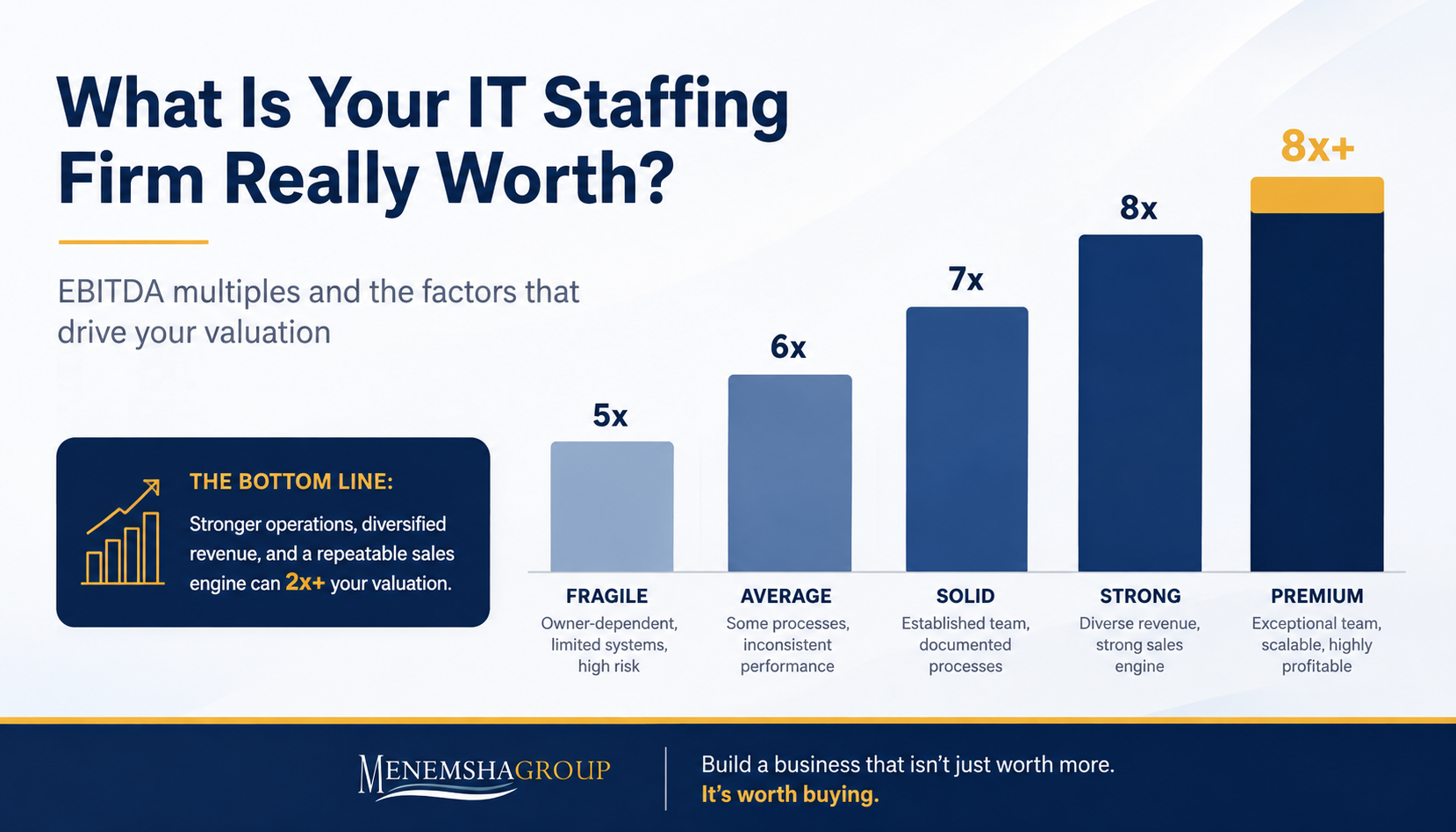
Buyers and private equity firms see this clearly. They're not buying your pipeline. They're buying the system that generates it. And if that system doesn't exist — if results rely on specific individuals, informal relationships, or tribal knowledge — they discount accordingly.
The impact shows up in three places:
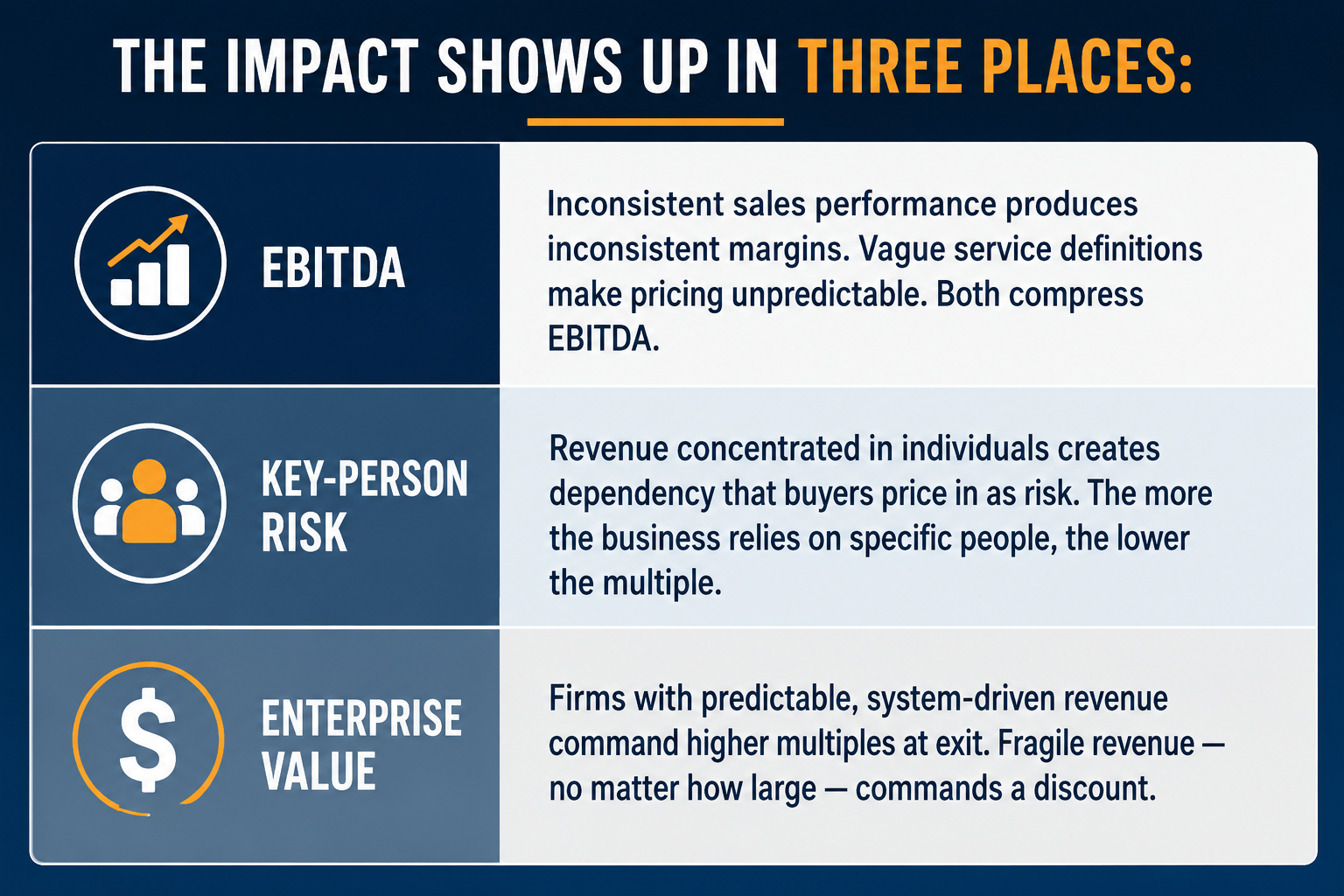
This is why go-to-market strategy is not a sales issue. It is a valuation issue. And it's why the work of building a GTM system isn't optional — it's the most important strategic investment a staffing firm's leadership can make.
What is a Go-to-Market Strategy?
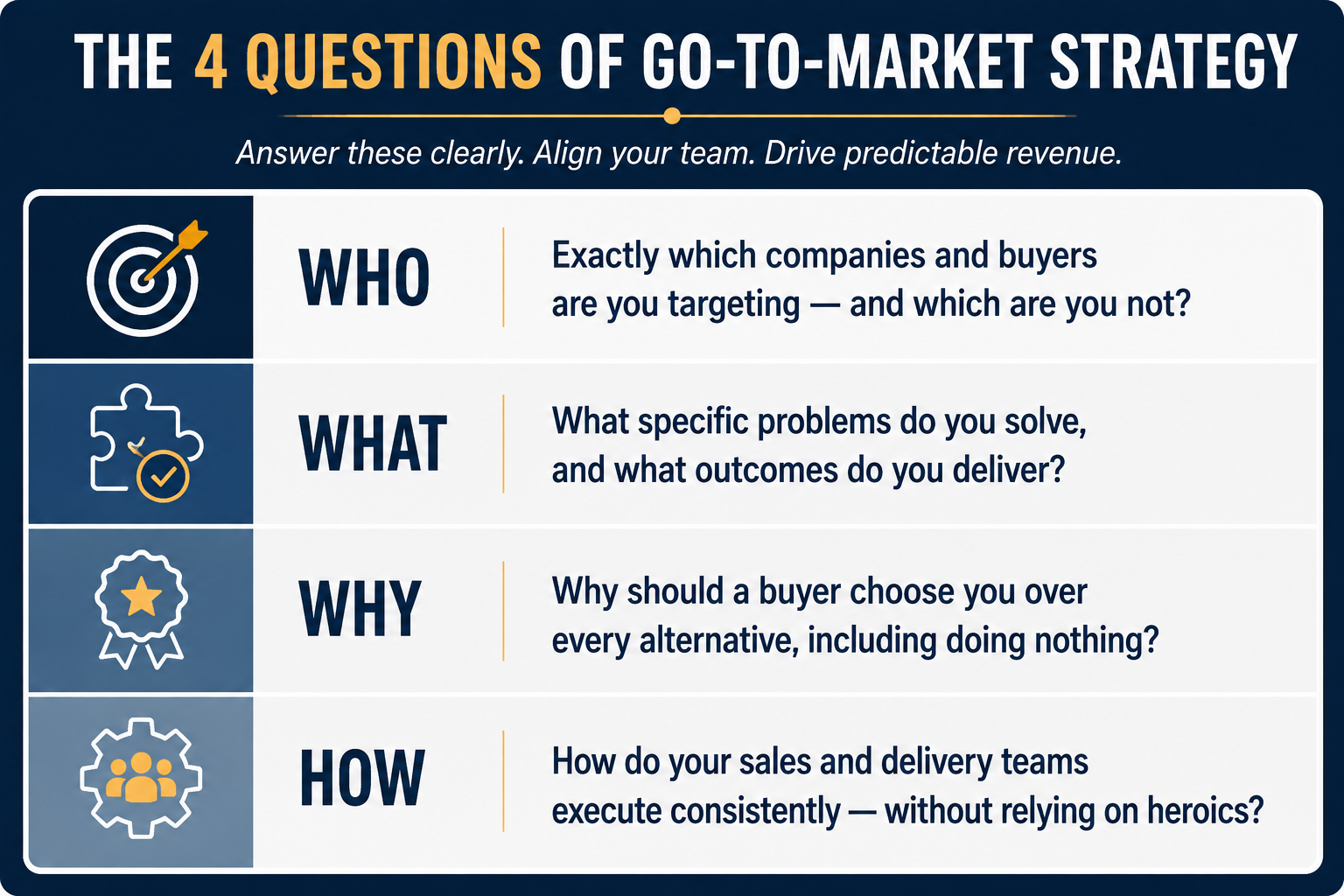
Your go-to-market (GTM) strategy is your blueprint for how your company brings its offering to market, reaches the right buyers, and consistently wins revenue. It defines who you sell to, what problem you solve for them, how you position your value, and how sales and recruiting execute together to close opportunities.
It answers four fundamental questions:
How Does Sales Enablement Turn GTM Strategy Into Execution?
Sales enablement is what turns those answers into daily execution. It's the system that ensures your GTM strategy shows up in rep behavior — consistently, at scale, without relying on individual memory or tribal knowledge.
Together, they create a machine: strategy defines the target and the message; enablement ensures the team can execute it; and the sales operating system measures whether it's working and where to improve.
Strategy doesn’t scale, systems do.
What Does an Effective Go-to-Market System Look Like?
When a go-to-market system is built and operationalized, the change is visible in the field:
Reps know exactly who to call. Because the ICP is defined, documented, and embedded in how they prioritize their week — not left to individual judgment.
Conversations are different. Reps lead with market insight and buyer-specific problems, not a pitch deck. Not price. Not “I’ll be in the neighborhood.” They sound like informed partners, not another vendor chasing business.
Value is quantified. Reps can articulate specific outcomes — not "we're great to work with," but "here's what changes when you work with us."
Deals advance faster. When messaging is aligned to how buyers actually make decisions, there's less back-and-forth, less ghosting, and fewer stalled deals.
Managers can coach. When there are standards — a defined sales methodology, qualification criteria, and conversion benchmarks — managers can inspect execution and coach it. Without standards, coaching is just opinion.
Results are repeatable. The system drives outcomes, not individual talent. That's what makes growth scalable and what makes a business valuable at exit.
The Question Worth Asking
If your sales team is underperforming, it's worth asking the harder question before you change another rep: Is the problem them — or the system you gave them?
In almost every case, the answer is the system. Or the absence of one.
Building a go-to-market system is not a quick fix. It requires leadership's time, honest self-assessment, and the willingness to define things that have been left intentionally vague. It's harder than hiring another rep. And it produces results that hiring another rep never will.
Go-to-Market Strategy isn’t a sales issue, it is a valuation issue.
What is a go-to-market strategy for a staffing firm?
A go-to-market strategy defines which companies and buyers your staffing firm targets, the problems you solve for them, how you position your value, why buyers should choose you, and how your sales and recruiting teams consistently execute that strategy.
How does go-to-market strategy affect EBITDA?
Go-to-market strategy affects the consistency of sales performance, pricing and margins. When services, pricing and sales execution vary from rep to rep, revenue and margins become less predictable. A repeatable go-to-market system helps create more consistent performance.
Why does key-person dependency affect staffing firm valuation?
When revenue depends heavily on a few salespeople, owners or customer relationships, that revenue carries greater risk. If those people leave, some of the revenue may leave with them. Buyers account for that dependency when evaluating the business.
What's the difference between go-to-market strategy and sales enablement?
Go-to-market strategy defines who you sell to, the problems you solve, your value proposition and how you go to market. Sales enablement turns that strategy into consistent sales behavior through methodology, tools, training, coaching and standards.
How do you make staffing firm revenue more predictable?
Predictable revenue requires moving critical sales knowledge out of individual people's heads and into a repeatable system. That includes clearly defined target markets, buyer personas, value propositions, sales methodology, qualification criteria, performance standards and coaching.
That's the shift I write about in my ebook, From Rainmakers to Revenue Systems: The System for Building Predictable Revenue and a Higher Multiple. If you're an IT staffing firm owner who's tired of feast-or-famine revenue and sales teams that depend on a few key people to hold everything together, it's a good place to start.
Download your free copy here.
And if you want to talk through what a structured onboarding system would look like at your firm specifically, I would be happy to have that conversation.

Dan Fisher is the founder of Menemsha Group and creator of the Menemsha Revenue Operating System™ (MROS) — an operating system built exclusively for IT staffing firms. Since founding the company in 2008, Dan has worked with over 500 IT staffing firms and trained thousands of sellers, recruiters, and leaders.
The Menemsha Revenue Operating System™ (MROS) replaces the "Sales Superhero Model" — where revenue depends on one or two key performers—with a complete operating system that defines who you sell to, how your team sells, the capabilities required to execute consistently, and how managers measure, coach, and improve performance—making revenue more predictable and scalable.
Dan Fisher: Aug 19, 2026, 8:45:46 AM
Why Your Sales Problem Is Actually a Valuation Problem: How Go-to-Market Strategy Drives EBITDA
Dan Fisher: Aug 6, 2026, 9:19:49 AM
ere's a question worth sitting with: if you sold your IT staffing firm and walked away, would your top clients stay — or would they follow you out...